We are very much afraid of the word magic, it has a bad name, for its meaning has degenerated and it has a purely superstitious sound in our ears. But magical was originally simply psychical, the ancients did not know of the existence of the psyche, so not being able to call anything psychic they used the word magic. ~Carl Jung, ETH Lecture XI, 3Feb1939, Page 71.
Magic is the working of men on men, but your magic action does not affect your neighbor; it affects you first, and only if you withstand it does an invisible effect pass from you to your neighbor. ~Carl Jung, The Red Book, Page 308.
The ancients devised magic to compel fate. They needed it to determine outer fate. We need it to determine inner fate and to find the way that we are unable to conceive. ~Carl Jung, The Red Book, Page 311.
In this post I would like to discuss something I have been doing for years, even before I became a Buddhist, and increasingly in past two years: magic (or magick, if you wish). Or should I say, magic as I see it; I don't claim to be an expert of any sort, with a lot of literary knowledge on subject: I am more of a doer. And as one might argue, that applies to my Buddhist practice as well. Precisely, I practice, everyday. I should read more... after all, study is one of the three basic elements of Nichiren Buddhism - faith, practice, and study.
However, I know enough to quote so called experts. Aleister Crowley formulated his definition of magic as "the science and art of causing change to occur in conformity with will." And, "every intentional act is a magical act." He also said: "Magic is real. And reality... it is magical."
I readily admit I'm inclined towards magical thinking, and I see nothing wrong with that; It makes life much more meaningful and fascinating, when you are able to see it this way: miraculous! I have often witnessed small occurrences, that strengthened my faith and trust also in bigger circumstances: everything is alright. Your spirituality is weighed in mundane. (Jung came up with a concept of Synchronicity, a meaningful coincidence.)
Of course the downside of magical thinking would be superstitious fear of the unknown, but I leave that for Christians. When I was a child I feared the dark, because of what might lurk in there; Now that I'm grown up, darkness is a friend who protectively covers me under her velvety cloak (I should write a poem!).
Also as a child, I remember how I used to see the shapes of people and animals in foliage of treetops against the sky. I can't see them anymore. I have been told I was not the only one. Jesus told us to become as little children to be able to enter into the kingdom of heaven. Children enjoy the world as it is with all their senses, without knowing of "evil" and "sin", and they still live in heaven here and now. So, I think "heaven" is a realm of creativity and imagination, and being like children is to surrender to this play in earnest, but not too seriously. As a child I used to create enormous imaginary worlds, and oh, how devotedly I prepared to play, before I even started! In latter age I realized it was related to my religious life: The same play was continued, just in the name of religion this time, the Holy Play, so to speak, and rituals and symbols were the language of that state of being, language of the subconscious mind. (I have a feeling I have used almost these exact words before, but I couldn't find where, and it doesn't matter; They still fit in here perfectly.)
Wikipedia article on Magic and religion, states: "Religion and magic became conceptually separated in the West where the distinction arose between supernatural events sanctioned by approved religious doctrine versus magic rooted in other religious sources. With the rise of Christianity this became characterized with the contrast between divine miracles versus folk religion, superstition, or occult speculation."
Modern study has questioned this contrast, and magic is rather seen as one of many forms of religious practice. Yes, we all know the bible reads, "Thou shalt not suffer a witch to live", among other things. Personally, I don't give a f**k. Nevertheless, what the bible says, it is full of descriptions of magical acts, and obviously in positive light when they are performed by the followers of Hebrew god. It's just not very interesting to me, as Non-Christian. I only see ignorance and hypocrisy of Christians. You don't see in your religion what you see in others. Yet, it is undeniably there. Just like bible is full of astrological stuff, no matter how "clearly" it seems to be forbidden. Besides, there are nowadays even Christo-pagans. And by the way, The Eucharist is a magical ritual throughout; see Stephan A. Hoeller, The Gnosis of the Eucharist.
John Myrdhin Reynolds, aka Vajranatha, writes about historical explanations of magic:
In ancient times among the Egyptians, Babylonians, and Greeks, and in medieval times until after the Renaissance, magic was explained in terms of the organic model of reality and the world. In this model, every thing and every event is connected with each other in terms of sympathies and correspondences. Magic was taken as an objective reality. But with the rise of modern science in the 17th century, these old explanations of how magic works no longer sufficed in the face of a clock-like mechanistic universe. So, in the next two centuries magic came to be explained in terms of energies, including subtle or occult energy which could not be detected by machines. However such energies may be experienced by our bodies and by our minds, which are far more sensitive instruments than any machine. At the beginning of the last century, with the influence of Freud and Jung, a psychological dimension was added to the explanations of magic, with psychic energy becoming the libido and the old gods and spirits being seen as psychological archetypes, or even projections. Quantum physics has moved beyond the old assumptions of earlier 19th century physics and the role of the subject or observer in the occurence of every event has come to be recognized.
So, what about Buddhism? In his lecture, "Magic, healing and ethics in Tibetan Buddhism", Sam van Schaik says: "When I use the term ‘Buddhist magic’ I mean rituals entirely performed for thiswordly ends, in which the ultimate aim of Buddhism - awakening - is only indirectly present in the practice, if at all. When buddhas and bodhisattvas appear in these practices, their role as saviour or exemplar of enlightenment is not forefronted, and their purpose is only to guarantee the effects of the magic spell. And ‘magic’ overlaps with ‘medicine’ in that specific remedies are prescribed for specific problems."
Author Trevor Corson writes about the magic of Buddhism, and he refers to important figure in history of Japanese Buddhism, who is fairly unknown in the West: a priest named Kukai, who founded Shingon sect, or "True Word" School, much older than better known Zen, and even today Shingon claims as many adherents in Japan as Zen. According to legend, Kukai is also a person attributed to introduce male same-sex love into Japan, which obviously isn't true: it has always been everywhere. Interesting story anyway, and a legend affirmed these relations in 17th century Japan.
Shingon is part of Vajrayana, Tantric Buddhism or esoteric Buddhism, just like Tibetan Buddhism: "emphasizing not quiet meditation but mystical magic"... "magical technologies for influencing the world—not for escaping from it"...
(Nichiren's critics on Shingon can be read here.)
Consciously and intentionally I rely on magic when I'm on the threshold: something needs to be left behind, and something new to be born. The most obvious time for this is the New Year's night. That is my oldest and consistently cyclic magical practice. When I became a Buddhist, I briefly considered abandoning my old habits, but it became clear to me that there was an inner need for that: It is the main point that your tradition feels vivid, and you don't do it just because you're accustomed to. On New Year's night the "energy" - for lack of a better word - can be very strong, as if all the wishes and good intentions of human race formed a kind of collective cloud you can draw from, and channel for your purpose. Like magic is vibrating all around in the air. New Year to me is the most important holiday. Ideally it includes both secular and sacred activities to an appropriate extent: you mustn't forget Champagne!
Today I just more blatantly embrace the fact that I do magic as well. As I see it, it is more like a "hobby" or something, that operates on the surface of reality, where the opposites appear; Whereas Buddhism to me is a profound conviction, reaching deeper levels of existence, where All is One. Opposition and separation are just the face of things; on a deeper level everything is interconnected. As I have said before, my philosophy seamlessly encloses a religion I practice, but it's not emptied by it, and my spirituality consists of manifold aspects, since man is manifold creature. You might be surprised that I consider myself very down-to-earth and critical. So, in case you wonder if I actually believe in all this, that's a tough one. I never claim, "This is the Truth". Some ideas are like useful tools. And if needed, you can trade them. In Buddhism, the word "faith" translated from the Pali language, is saddha (shraddha in Sanskrit), literally meaning "to place the heart upon". It is not blind belief or submission to the authority. One needs trust or confidence in their practice and their own potential.
My spiritual "idol" today is not some Guru on a pedestal, but a fellow practitioner (of different tradition) much like myself; I can relate to many things she's gone through on her own path: Zeena Schreck. For over twenty years she has been a Vajrayana Buddhist, but as her website also says: "Zeena incorporates into her personal practices and teachings decades long study, practice and personal gnosis of Gnostic Sethian theurgy traditions, stemming from the ancient worship and primordial magical practices of the Egyptian deity Seth." But it is strongly stressed that "Zeena has... received instruction from her heart Lama Ayang Rinpoche on how to properly practice both Buddhism and Sethian theurgy without contradicting her Buddhist vows. This is applied in the same manner as with Buddhist practitioners who originally are of other religions, such as Christian or Hindu, who still maintain aspects of their original faiths at the same time as recognizing those faiths are not the true route to Liberation, Enlightenment and Omniscience as taught by the Buddha Shakyamuni. It should therefore be understood, that in no way does Zeena conflate her Sethian practices and teachings... with the Buddhist ones. Nor does she blend them together as many occultists, secular humanist, atheists, academics, and religious zealots of all persuasions, wrongly assume."

 |
| My drawing 1992 |
On this video below, "Does Prayer actually work?", Morgue gives some good points to consider. According to him, prayer is a weak form of magic. Why weak? Because it transfers the power away from you - you give it to god, spirit, godhead. You project your power on something outside. Under the will of that godhead, you have bound yourself. There is no metaphysical force out there, Morgue argues, godhead exists in your mind, and your mind is powerful and makes things happen. Magic, on the other hand, emphasizes the willpower of a practitioner: If you work with the spirit, you don't beg, you command! You are a magician in the middle of circle, and everything revolves around you. You represent the central point of the universe in microcosm. Spirits don't really exist, they are aspects of your own consciousness. You are balancing your psyche, as advanced magician knows. The more complex the spell, the more it works your unconscious mind (like, if you write something down once, you may forget it; if you write it hundred times, you will more likely remember). The spell in itself won't do anything, it activates unconscious effort in your mind, and nothing impossible can occur. It is like placebo, often underrated, but its effect is real, and science can not fully explain it. Magic is transforming yourself, and through that you impact on others and change the world. That's a brief summary of video.
In some Buddhist traditions, "prayer plays only an ancillary role" (Wikipedia); "It is largely a ritual expression of wishes for success in the practice and in helping all beings." Especially Soka Gakkai International seemingly likes to use a word prayer, which I think may be a little misleading in Buddhist context, as it easily conjures up a Christian idea. A word meditation could be used instead. Corresponding Finnish Wikipedia article says that the style of prayer in Nichiren Buddhism, when you recite the verses of the Lotus Sutra, is close to Western idea of prayer, but as it is added: Praying here can be understood as a process of deepening self-knowledge, which enables one to evolve as a human being.
Sometimes it seems that in SGI people try to gain benefits by chanting, to achieve their goals in material world. Some people even refer to manifestation and the laws of attraction in this context, which is far-fetched and alien to me, and I don't mean to deny the conception altogether, it's just not Buddhism; mantra is not a magical formula. Even as a Christian, I didn't want to pray for some specific outcome or a concrete goal to be fulfilled, because it seemed too egoistic to me. And that is exactly what many Christians do. Yes, Jesus said, "You may ask me for anything in my name, and I will do it." (John 14:14 NIV), but it needs to be put into perspective with his other words: "Your Father knows what you need before you ask him." (Matthew 6:8 NIV), and "If you then, though you are evil, know how to give good gifts to your children, how much more will your Father in heaven give the Holy Spirit to those who ask him!" (Luke 11:13 NIV) Holy Spirit, Bread of Life, spiritual sustenance... Our Daily Bread in The Lord's Prayer. This is universal perspective. Spiritual development, enlightenment, is our primary goal. Every possible good attainment in life is a spin-off beside that.
Only now in 2024 I found out about ancient Egyptian concept called Heka, and I think it is fascinating! Never before have I even heard about this, which is odd since I consider myself very educated on these matters, and instantly I was attracted to this idea, as sometimes may happen to me. I put the links at the bottom, but first I try to gather some main points together...

Heka was the deification of magic and medicine in ancient Egypt. The name is the Egyptian word for "magic", and literally translates as "using the ka", also explained as "the first work".
 |
| "Heka". Papyrus scroll on the right is a symbol of an abstract concept |
 |
| God Heka |
He is sometimes seen in Egyptian art in the boat of the sun along with other personified elements, namely Sia (perception or insight) and Hu (creative utterance, authoritative speech). To human beings, he finds expression in the heart and the tongue, represented by gods Sia and Hu. Heka was the power which infused both. He was linked to the creative aspects of the heart and the tongue. The heart was considered the seat of one's individual personality, thought, and feeling, while the tongue gave expression to these aspects. In the same way that Heka, Sia, and Hu enabled the gods to first create the world, they allowed human beings to think, feel, and express themselves.
According to myth, the god Heka fought and overcame two serpents. These serpents then became part of Heka's symbol, symbolic of his power, with two snakes above the head. He is connected with the caduceus (a winged staff with two serpents wrapped around it), now a symbol associated with medicine. He was generally depicted carrying a magic staff and a knife, the tools of a healer, as a man in royal dress wearing the regal curved beard of the gods. Heka had no formal ritual worship, no cult following, and no temples (except in the late period of ancient Egypt, 525 - 323 BCE).
The concept of Heka lacks clear boundaries between ancient Egyptian magic, religion, and medicine. Heka was not limited to active rituals but it was a power that permeated life. Practitioners of magic were often temple priests, and magic was neither positive nor negative; it was a cosmic force that could be used to destroy or to protect, a natural force that could be harnessed and manipulated by deity or man for either harm or protection. Egyptian physicians called themselves "priests of Heka".
According to texts, Heka existed before duality had yet come into being, without parents, without origin. In origin stories, the creator god, Atum, uses heka to make the world. Every aspect of the universe is made of heka. It has been likened to an “all pervading coercive power—comparable to the laws of nature in its coerciveness and all pervadingness—by which in the beginning the world was made, by which it is daily maintained and by which mankind is ruled.” (Jan Assman, Magic and Theology in Ancient Egypt) It is a force that created and propelled the universe, but could also be manipulated by the actions, words, objects and images to bring about a desired result.
Odgen Goelet (Ph.D. in ancient Egyptian history) explains:
Heka magic is many things, but, above all, it has a close association with speech and the power of the word. In the realm of Egyptian magic, actions did not necessarily speak louder than words – they were often one and the same thing. Thought, deed, image, and power are theoretically united in the concept of Heka.
The Greek and Roman Stoics would later write of the Logos and the Neo-Platonists of the Nous - a force which flowed through and bound all things together but was, at the same time, distinct from creation and eternal - and so Heka lived on under these different names. The influence of the Neo-Platonists on the development of religious beliefs is well established, and so Heka continued as he always did; the invisible force behind the visible gods.
Maybe you wonder why I use so much space for this ancient Egyptian concept. I don't know if you are able to understand what I try to say... I don't need explanations to satisfy my reason, I receive inspiration, like at the magnificent piece of Art. Although I'm sure different mind (absolute and literal, that is) would overanalyze that too. I rather let it speak to me. Yet at the same time I'm skeptical about many things that don't make sense to me; It is a paradox of spirituality. Ancient Egyptian religion is no longer a living tradition, but Western Occultism and Esoterism often claim to trace their origin back to Ancient Egypt. So why not take an advantage of it.
 |
| Reiki |
In New Year I write a list of things I wish to let go (and nowadays also a list of things I'm grateful for, just for the balance). I have a bowl of water, and stones. Going through the list, I pick up a stone with every item, take a deep breath and squeeze the stone in my fist, then drop it in the water and exhale. Finally I burn the list. This simple exercise has proven very effective in releasing negative emotions, especially quilt, like when my partner died, and I thought about everything I had done or hadn't done or said. Although in normal circumstances I no longer find many things I would regret: Along with my Christianity I gave up my quilt.
Still every New Year I have done an online Tarot reading - a reminder from the 1990's, when I was very much into New Age. Nowadays it's more like an entertainment. This year my husband actually wanted to buy physical Tarot cards, so next time I will use them. But this is the free site I can recommend: Facade.
Likewise, I write down my goal for the next year, and close it in the envelope and seal it. It is precisely the point that I will forget it, but hopefully it is imprinted on my subconscious mind. The most exciting example of what might happen is this: In the end of 2015 when my partner had just died, I had written that "I am open for Love". I didn't remember that as I opened the envelope in the end of 2016, and it just happened that I had met my husband and fell in love with him! And I can assure you it is not something that happens to me all the time! Another goal actualized was permanent employment. Things don't just happen by themselves, it is I opening up for opportunity - that needs to be emphasized.
 |
| My Baphomet candle |
 |
| My ritual dagger |
Last year I had enough of my increasing negative emotions towards my late partner (see "New Revelations"). They made me question the whole relationship of nearly 19 years, and threatened to poison the significance of his death, as I once experienced it (see "Through Death to Love"). Suddenly I had a dream I frequently had during the first year after his passing: I was with him, and all I could think about was how to tell him I don't want to be with him, because I have someone else. This time I felt distressed, and I was relieved when I woke up; A dream had become a nightmare. It was the last straw.
So I decided to begin a "magical process", as I called it. All in all, it took about four months. I "purified" my life with him using Reiki, one year at a time for one week, 15 minutes every night. I slowly burned out the candle our mutual friend - and still a friend for me and my current husband - gifted for X-mas 2015, after my partner had died, and I preserved it as a token of memory until now.
Just like I used to talk to my partner every night for three months after his passing, now I wrote a letter, highlighting the fact that then I felt he was still close to me, now he's distant both emotionally and temporally. Finally, I burned the letter, as you may have already guessed. I made a minor "pilgrimage/retreat" on a place of our engagement ritual, in the forest by the lake. Just sitting on a rock, watching the lake, listening to the waves. For long time after his death I felt an urge to visit there once a year, and it is relatively hard to get there, and a long way. Now that urge seems to be gone. Needless to say, my magical process was a success! It came to an end, and is never to be revisited. Here I only gave a few outlines, not the whole procedure.
 |
| Place of our engagement ritual in 1999, after two years together; Rock in the middle was an altar, and the four elements witnessed. Ashes of our four beloved cats have been buried there, along with a tuft of my late partner's hair |
Last summer I established a new similar and yet very different "sacred place" for myself alone. It is a large rock by the bank of nearby pond. Located at a nature conservation area, just next to the jogging path. It is very close to my home and easily accessible. I go there around midnight (hence I can't take a picture), when it is really quiet and peaceful. I may even lie down on a rock, staring at the starry sky. When I arrive, I draw the power symbol of Reiki with my finger on the rock; When I leave, I chant Daimoku (Namu Myoho Renge Kyo) three times. I have also started to hug trees, as I did in the 1990's (first asking for permission, and thanking afterwards): it is like meeting old friends - they are living beings after all ("Trees are poems that the earth writes upon the sky..." - Kahlil Gibran).
Only later I realized it is grounding or earthing what I'm doing, and what I really needed. It is refreshing. That's where the magic comes from: It's a natural force. That's why I associate my magic with paganism. In terms of Divinity, it is surely present in nature. I like to call it simply Life or Universe; Both we can observe and understand, they are around us, and we are also part of them. Yet much more is veiled in mystery, and still beyond human comprehension. We are in this body, in this world, for a reason. We are where we're meant to be. And it is good. It's just life as it is.
This Fall it became necessary to perform a magical ritual for my troubled relationship with an old friend (see "Beyond Words"). It's been going on for years, and I'm really tired of that drama for good, even though my distress is very real, not overstated at all! Again, I don't go to details, but first I showered (purified from negativity), I remained nude (honest and real). I wrote a rhyming spell (rhyming, to make a conscious effort) on a pink paper, and lit a pink candle. I made a list of his good qualities. I had an old photograph of him (from 1999 when we had just met. On the back of photo, I have written: "My kindred spirit". That's how I saw him back then), and a mirror to reflect myself. After ritual, I fully understood it is true what I have suspected: I do project myself on him, everything I have left behind, or don't want to see in myself; everything I hate about myself. Like, I've got this obsessive idea that I'm mentally strong, I have to be strong, and I can survive anything, on my own. (Even though I have a reverse experience as well!) I see weakness in him, and I hate it.
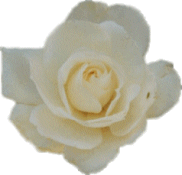
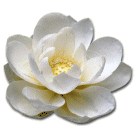
I also drew a picture I have been planning for years, thinking about us: Buddha and Jesus, just two human beings without halos, commonly drinking tea together, as friends. There is a white rose, a symbol of our small spiritual gathering long time ago, but also a white lotus, as in the Lotus Sutra: Spiritual symbols of both West and East. And a phrase in Latin: "Vacate et Scire" - "be still and know"... as in the Psalm 46:10, but "vacate" can be translated, "Be free"; "Empty yourself"; "Make space"... and know - making its meaning even deeper. A reference to silent meditation, as I see it. This picture is like the abstract of this particular magical act.
Our first meeting after this ritual was promising: I was able to be more straightforward than before. I even suggested that next time we should quietly just sit and meditate together for starters, and we already settled a date. Something I have been thinking for a long time. I gave him my drawing: In a way, I poured myself into it, so let it work its own magic; He can form his own opinion, and next time I can tell him what I was thinking as I drew it.
Even now he managed to get me annoyed - which I was able to say out loud right away. This was not the first time. He repeatedly says that he doesn't care about religions - unlike I see him - yet he always refers to Christianity, and how something spiritual is truly "Christian" when he likes it (he once traveled to Egypt, and told that moral behavior of some Muslim women was in fact "Christian"). His use of a word makes it meaningless. When he tells about his spiritual journey, and how he has experienced what is true, they are the truths of Christian religion he's talking about. As I see it, it doesn't leave much space for other religions and different truths, for he knows the truth - not a fragment of it, like the rest of us mortals, but the whole truth - and it is superior. It seems pointless to try to explain that I have my own spiritual journey, and I have experienced many things too.
It is okay to say, "this is my journey, this is my truth"; it is not okay to say, "this is the truth, and I know it." Or else you lack a sense of proportion, and are just a dick, like each and every Christian (well, maybe not everyone). It's not far from saying, "God told me so; Repent, you unbeliever!" He makes a distinction between himself and "ordinary believers", as he calls them, but some minor specifics (like Reincarnation) don't make him more than just another believer in my eyes. Seems to me he can't distinguish plain spiritual experience from his own interpretation of it, based on his belief system. (Absolute and literal mind, as mentioned before: It's all either black or white.)
That's my impression anyway. Is it just my misinterpretation, or maybe he's expressing his thoughts poorly... or maybe I see arrogance because I'm arrogant? Or maybe he is. My thoughts about him may often be disparaging, so is it wonder if that's what I expect from him too? I can't really ask for respect, unless I show respect. He is not a problem, I have a problem. It's all about my thoughts and my feelings... And perhaps part of a problem is that I don't really know his thoughts and feelings. One time earlier, I opened my heart, and I was so relieved, but he didn't say much. Anyway, magic is primarily affecting me, and through me indirectly on him. I can feel it. Even I don't know what I unleashed.
I don't think it was religion that united us in the first place. For over ten years as an active member of The Christian Community, I never made friends with anyone else. Rather I think it was mutual likeness we both recognized: Two broken souls attracted one another. And that likeness was what I had enough. In spiritual groups I always felt like I'm playing a role. A single common ideal doesn't unite people very well. Today I have stopped pretending to be something I'm not. The fact that I see how far I am from my ideal, paradoxically proves me I'm on the right track. Enlightenment is increasing self-knowledge, by small insights: Not a sudden, undisputed mystical experience, that changes everything all at once.
The spell I cast, has two possible end results, because I don't know what I want, or what is best for us: Either it will heal our relationship, or it will help to let go. You can not fix what is not broken. We don't have very much in common anymore. It is only natural that people change, and their relationships change accordingly. Sometimes people grow apart. It doesn't concern only lovers. There is no forever on earth. The fact that I only have few friends, and he's the second oldest one, may not be reason enough to cling to relationship, if it's not working. I used to have a friend - straight male - from school, who was important to me growing up. When I had my "spiritual awakening" in my 20's, we started to drift apart (or I did), because suddenly that was my whole life, and all I wanted to talk about, and it was like invisible wall between us. I was a drama queen and ended our friendship with a letter. Two years later he approached to me again, and I learnt I made him depressed and suicidal! That was a shock. I didn't think I could matter that much for him. I only thought about myself obviously. We renewed our friendship, and spent wonderful summer together. Soon after that our relationship started to weaken naturally, since I moved away, and also he was the only person in my life who reacted badly when I came out to him. Nowadays he is just another name among my Facebook friends. Then I met this other guy, also a straight male, and the tables have turned: Today he would like to talk about spirituality, I don't.
Perhaps my goal for the next year should be making a new friend? In my case that really requires magic!
 |
| My drawing |
Links:
Dr. Flora Brooke Anthony: Heka: Understanding Egyptian Magic On Its Own Terms
Thomas Ellison: Magic in the Ancient World: Egyptian Deities and Uses