
1.
How many commandments did Jesus Christ give to his followers for guidance of life?
Two general ones and five detailed ones, seven commandments altogether.
2.
Are these commandments as such in a sense of the law, a punishment being followed by its disobedience?No. Law was until the Christ, but after him there is a gospel or the Good News.
3.
What does it mean? It means that man is now a free being, who will decide by himself what he thinks is the truth and in what measure he wants to develope spiritually. Commandments of Jesus are not threats but promises. They don't say: You must or else; They say: Do this and you will discover the truth and be happy. They are advices for life, ideals Christ is showing us in inner illumination.
4.
What is the first general advice for life?God is the spirit and his kingdom is in us. The kingdom of God must be seeked first before all material values and he must be served in spirit and truth.
5.
What does this mean?That we must not "fear" any outer gods, because the only god man is to love and serve is the Father who makes himself known in man's own spirit, and knowledge of him is constantly growing and deepening. His kingdom is in us and we don't have spiritual knowledge of life until we have opened up the gates to his kingdom of truth in our own consciousness.
6.
How can we get to know inner kingdom of God?
By seeking for truth with all our heart, all our soul, and all our mind. Therefore Jesus says that even in the law it is the greatest and first commandment: Love the Lord your God with all your heart, and all your soul, and all your mind. Few people then understood that "the Lord God" was to be seeked from man himself, but after the Good News of Christ everyone may freely know that kingdom of God is within.
7.
What is the second general advice for life? Christ has expressed that by his following words: A new commandment I give unto you, that ye love on another; as I have loved you, that ye also love one another.
8.
Is this second advice in relation with a previous one?If a man in inner awakening "sees God", he will also see that God, who is the spirit of love, makes him love his human brothers. And then if a man loves his brothers, this love irresistibly takes him to know God the Father. As Jesus says, in old law the second commandment "to love your neighbor as yourself" was equal to the first one and on these two commandments hang all the law and the prophets. But love that was duty in the law, is the bliss of life in the gospel.
9.
What for Jesus calls this second instruction a new one?Because he wishes and wills that love with which a Christian loves his brothers is to be like love with which Jesus loved. And he says: By this shall all men know that ye are my disciples, if ye have love one to another.
10.
Was the love of Jesus new in quality?Yes. It was new in both its spirit and its form of expression, compared to love the Jewish usually had an idea of.
11.
What was the love like Jesus wanted his disciples to love one another?It appears and is expressed through five detailed commandments.
12.
What is the first detailed commandment?Do not get angry.
13.
Does it include a new idea of love?Yes. Jesus says: Ye have heard that it was said by them of old time, Thou shalt not kill; and whosoever shall kill shall be in danger of the judgement. But I say unto you, that whosoever is angry with his brother without a cause shall be in danger of the judgement: and whosoever shall say to his brother, Raca, shall be in danger of the counsil: but whosoever shall say, Thou fool, shall be in danger of hell fire.
These words include a new idea of love, because God of the Jewish has denyed killing but Father of love denyes getting angry too.
14.
Did Jesus make old denial of killing insignificant by his new commandment not to get angry?No. Old commandment is included in the new one, because the follower of Christ must not get angry, he won't kill either.
15.
What is second detailed commandment? Be not impure even in your thoughts.
16.
Does this include a new idea of love?
Yes. Jesus says: Ye have heard that it was said by them of old time, Thou shalt not commit adultery: But I say unto you that whosoever looketh on a woman to lust after her hath committed adultery with her already in his heart.
17.
Does Jesus make an old commandment insignificant?No. Old commandment in included in the new one, because a Christian who musn't be impure in thoughts won't commit adultery. Christ's instuctions of life are more beautiful, finer, and therefore more moral than those of Moses, because they are the ideals of love. Jesus adds: It hath been said, whosoever shall put away his wife, saving for the cause of fornication, causeth her to commit adultery: and whosoever shall marry her that is divorced committeth adultery.
18.
What is the third detailed commandment?
Don't swear, don't take an oath, but always speak true.
19.
Does this include a new idea of love? Yes. Jesus says: Again, ye have heard that it hath been said by them of old time, Thou shalt not forswear thyself, but shalt perform unto the Lord thine oaths: But I say unto you, Swear not at all... But let your communication be, Yea, yea; Nay, nay: for whatsoever is more than these cometh of evil.
20.
What is the point of this commandment?Jesus denyes promising in regard to future. His follower remains in truth, is honest to oneself and to others, and will not bind with his words in regard to future if it is in his controll.
21.
But is not for instance Marriage based on promises and words?No. Marriage is based on action and is as natural as life.
22.
Is taking an oath in the court denyed?For true Christian taking an oath is useless, because he speaks true in any case.
23.
Who is true Christian?Only the one who in his life follows Jesus Christ, obeys his commandments and instructions.
24.
What is the fourth detailed commandment? Do not resist the one who is evil.
25.
Does this include a new idea of love?Yes. Jesus says: Ye have heard that it hath been said, An eye for an eye, and a tooth for a tooth: But I say unto you that ye resist no evil: but whosoever shall smite thee on thy right cheek, turn to him the other also. And if any man will sue thee at the law, and take away thy coat, let him have thy cloke also. And whosoever shall compel thee to go a mile, go with him twain. Give to him that asketh thee, and from him that would borrow of thee turn not thou away.
26.
Is the old commandment made insignificant by the new one?Yes. The old one is based on revenge and justice, new one on forgiveness and love.
27.
What is the fifth and last detailed commandment?Love your enemies.
28.
Does this include a new idea of love?
Yes. Jesus says: Ye have heard that it hath been said, Thou shalt love thy neighbour, and hate thine enemy. But I say unto you, Love your enemies, bless them that curse you, do good to them that hate you, and pray for them which despitefully use you, and persecute you; That ye may be the children of your Father which is in heaven: for he maketh his sun

to rise on the evil and on the good, and sendeth rain on the just and on the unjust. For if ye love them which love you, what reward have ye? Do not even the publicans the same? And if ye salute your brethren only, what do ye more than others? Do not even the publicans so?
29.
What is the point of the new commandment?A Christian won't make war. Original word translated into "enemy", does not mean personal enemy to whom you must "do good", but political enemy, a stranger, member of another nation; he has to be loved.
30.
Does Jesus Christ forbid making war?He does, from all those who want to follow him and be his disciples.
31.
Why has Christendom always been making war and churches have prayed in Christ's name each for the troops of its own country?So called Christendom and so called Christian churches don't know Jesus Christ or his doctrine of life; they don't always follow it but deny it, at the same time denying their master and saviour.
32.
Could the Finnish nation be Christian and follow Jesus? Wouldn't enemies then attack the country and destroy whole nation?Finnish nation as a nation cannot be Christian unless every citizen is a Christian. Individuals as individuals follow Jesus Christ, and in the visible world nation is just a sum of its individuals. But if all the individuals of the nation would be Christian, then there were no more "enemies" which would attack the country.
33.
In what commandment Jesus has united the five previous ones?In the following: Be ye therefore perfect, even as your Father which is in heaven is perfect.
Faith and Knowledge
34. What is Faith?
Faith is a spiritual force dwelling in man's consciousness, it unites him with all-encompassing and everlasting spirit of life, or God.
35. Is Faith dependent on doctrines or dealing with some dogmas?
Not directly. Faith is not regarding some doctrine or dogma true, but it is inner conviction, knowledge and devotion to the Father of life. Many kinds of doctrines and dogmas may prevent awakening of Faith, unless a man can think and judge, although Faith once awakened is seeking and receiving help through thinking and the activity of intellect.
36. How is Faith awakened?
Faith will be awakened by itself, since it is a spiritual force.
37. What will cause this awakening?
Man's sincere seeking for truth, which does not happen only with all his mind and reason, but also with all his soul and heart.
38. Can Faith be defined more precisely?
Yes. Faith in God analyzed more precisely is Faith in the Father, the Son, and the Holy Spirit.
39. What is Faith in the Father?
Faith in the Father is the actual and absolute content of Faith. It requires that man in his search for truth has reached a point where he doesn't see existence merely as material phenomenon, a senseless nature, caused by liveless laws of coinsidence, but he is positive that the visible universe is like a great body with God as its living and conscius soul. Faith in the Father also requires and includes that man is positive of the good will and love of the God of the universe for the world, and especially that God loves with unchanging and everlasting love each human soul. Faith in the Father is focused in the fact that God in his love wills to surrender to man and help him to gain the goal of his life and because of that, God is as if waiting at the door of man's soul and heart.
40. What is the meaning of life?
Jesus said: Be ye therefore perfect, even as your Father which is in heaven is perfect.
41. Is this possible with a man?
Not with a man alone, but through the help of God for sure. Jesus Christ did not speak in vain.
42. What is Faith in the Son?
Faith in the Son is Faith that man's spirit is one with a spirit of God. That spirit within a man is called the Son of God or Christ, which he will attain in Faith. The secret spirit of man is the Son of God.
43.
How is Jesus Christ in relation with this?Jesus of Nasareth was a man in whom the Christ or the Son of God had developed in its full potential, so that the one who saw Jesus Christ, saw tha Father too.
44.
Is Jesus Christ the Saviour of the world?
Yes he is, because he was the first among brethren who attained a full felationship with the Father.
45.
Are we to believe in Jesus Christ?Yes of course: We must surrender with full confidence to the leadership of Jesus. Our Christianity is in following Jesus who is for us the way, the truth, and the life, because he has let us known the Father.
46.
Was Jesus God? No. Jesus was a man like us, but Christ was and is the Son of God in human spirit. And because Christ fulfilled Jesus completely, Jesus' deeds and words, his thoughts and feelings were deeds and words of the Son of God, thoughts and feelings of the Son of God. That's why Jesus didn't speak or act, but the Father God spoke and acted in him and through him.
47.
Can anyone attain the same perfection as Christ?Jesus said: Follow me and you will do even greater things than I have done, but a few people have yet dared to follow Jesus.
48.
What is Faith in the Holy Spirit?Faith in the Holy Spirit is Faith and trust in the spirit of truth, which enlivens the sincere and honest man who's seeking for the truth, power of truth. It is firm trust that the power of truthwill take a seeker to God. Faith in the Holy Spirit is Faith that the Father God will help man who first of all is seeking for the kingdom of God, so that he will find that kingdom. As Jesus said: Seek, and you will find. The Holy Spirit of truth helps our soul to find God by opening the gates to that heavenly kingdom of our spirit where Father is a ruler.
49.
So will Faith begin from the Holy Spirit?Yes. Our soul will first receive love of the truth and the Holy Spirit of seeking, and then it goes through the Son to the Father. It is true Christianity as Christ also said: God so loved the world, that he gave his only begotten son, that whosoever believeth in him should not perish, but have eternal life.
50.
Does Jesus call himself the only begotten Son of God in these words?Not at all. The only begotten Son of God is Christ in us, Christ in Jesus too. Jesus was a man.
51.
What is eternal life?Eternal life is life in God.
52.
Will it begin after death or in so called resurrection?Eternal life begins at the moment when a man in his spirit becomes aware of the presence of the Father, and feels and knows he is the Son of God. Eternal life is independent of time and lives in time as well as above time.
53.
Does bodily resurrection exist?Yes.
54.
What is it?Everyone who has not attained perfection, will rise again from the death, that is, he will be born or incarnated again on earth, in order to have another opportunity to search for God he has not found yet.
55.
Will his old body rise from the death?No. Old body has vanished into its original particles, but immortal spirit will wear again a material body which is a new one.
56.
Is nobody eternally damned?Nobody.
57.
But the Christendom believes there is hell?It was a mistake of the church in the middle age. When it condemned a dictrine of reincarnation as herecy, there was left only hell for those who didn't think dogmas of the church were true.
58.
Does reincarnation belong to correct Faith?No doctrine belongs to Faith, because Faith is a spiritual force and view. Faith is man's innermost and the most secret ability.
59.
How is a Christian to regard the doctrines and dogmas, for example reincarnation?He must consider them with his reason, heart, and moral sense, ponder and meditate them, and as the apostle says, study everything.
60.
How will he know which doctrine is true, which is wrong?The Holy Spirit of truth which is effective in him, will help him to avoid wrong and false doctrines, until he'll become the one who knows and who will see the truth by himself.
61.
Can a man become the one who knows the truth? Doesn't he always need to have Faith?Faith never disappears in man, because Faith is a moral force, spiritual life, which unites him with the Father God. But when he has attained the life of Faith, inner senses will awake in him, new soul qualities, that will open new unknown worlds to his exploring reason and thought. He has an opportunity to study step by step ever greater and deeper secrets of life and nature, and he no longer needs to regargd the doctrines or dogmas true, but he's able to explore and see what facts and truths there are behind the doctrines.
62.
Church has always taught that man cannot know divine secrets but he's forced to believe in them. Church is wrong, because the apostle says that the spirit searches all things, even the deep things of God. But before his inner senses have been opened in man, he believes or more precisely, regards true what the seers and those who know are telling and have told about things of the invisible world.
63.
If Faith always remains, which is higher: Faith or knowledge?Faith and knowledge are not contradicted to each other. To think something is true, and knowledge, are opposites to each other, because when a man knows something, he no longer needs to think it's true. Faith instead is a moral force, which is not the opposite to knowledge, but the birth-giver to knowledge.
64.
Is Faith the birth-giver to scientific knowledge, for instance?Faith in the Holy Spirit of truth is, because all Faith was born out of trust that knowledge is attainable. And when Faith in the Holy Spirit of truth has grown to Faith in the Son and the Father, it will bring forth so called secret knowledge.
The Kingdom of God
65.
What is the Kingdom of God?Kingdom of God or heaven is the secret kingdom of our spirit where Father is a ruler. As invisible reality for mortal eye, it is the holy union or brotherhood of all those living creatures, men, angels, etc. who joyfully obey the will of the Father.
66.
Where is the Kingdom of God?Jesus said: The Kingdom of God does not come with your careful observation, nor will people say, 'Here it is', or 'There it is,' because the Kingdom of God is within you.
67.
Is it in each one of us?In a way yes, but we are not in it.
68.
How can we get into it?Jesus said: "Strait is the gate, and narrow is the way, which leadeth unto life." The gate of the Kingdom of God will be opened only for the one who is looking for it and who believes in the Holy Spirit and is helped by the Holy Spirit.
69.
Are we to look for the Kingdom of God?
Yes, and as men there is nothing else we can do. There is the truth, the perfection, and the life in the kingdom of God. As men we cannot possibly be without these; as reasonable beings we miss the truth, as moral beings we miss perfection, and as spiritual beings we miss eternal life. Unless we look for God, we won't find peace anywhere.
70.
What for the Kingdom of God is called the kingdom where the Father rules?Because the will of God is the only ordering law that all obey.
71.
What is the will of the Father? Will of the Father is truth and love. Jesus has described that in his commandments.
72.
Is will of the Father always done?It is in the Kingdom of heavens but not on earth as long as people don't want to obey it.
73.
Isn't the Father ruling on earth?Not directly. Jesus is teaching us to pray: "Your will be done on earth as it is in heavens." The purpose of his followers is to hasten the coming of the Kingdom of heavens in visible world too; therefore they pray: "Your Kingdom come."
74.
Why does Jesus say, not one of sparrows is forgotten by God. Doesn't this mean that God's will is done on earth too?It means exactly as it says, that Father allows everything to happen. Father won't resist suffering, nor evil. Father has given up a direct power over nature; he has also given up direct power over human life: Manifestations of his will in disguise are the fate and destiny, by which suffering is the teacher of men. But Father's own will is only done directly in the Kingdom of God (which is not local but idealistic reality).
75. Is there no suffering in the Kingdom of God?
No. The Kingdom of God is bliss and peace.
76.
Is man released from suffering when entering the Kingdom of God?Not immadiately, nor completely, until all people have received the Kingdom of God. Everyone has his destiny or his cross; but instead of complaining his destiny as before, he will carry his cross with joy and gratitude when he has entered the Kingdom of heavens. The cross prevents him to do Father's will fully freely, but at the same time it helps him to stay humble and patient and always to try.
77.
What is the cross? Partly it is man's outward destiny in the world, partly his own weaknesses, faults and sins. They all must be carried with joy while following Jesus.
78.
Will suffering decrease by the time?It may either decrease or increase, depending on how much there is suffering in man's destiny as a consequence of his past lifes, and how much strength he's got to carry it. Spiritually strong man takes big burdens on him. But it is sure that personal suffering will one day end.
79.
Personal? Does not suffering in general end?When a man no longer suffers for his own sins, he will take sins of others upon him and suffer for others. But then his suffering is that of Christ, and the secret of that suffering is bliss.
80.
When will the suffering in general end?When the Kingdom of God has been realized on earth.
81.
How will it be realized?When men obey Jesus' instructions of life and live in spirit united with the Father, doing even the slightest hue of his will. When nobody's getting angry, lusting, lieing, being violent, making war, judging, imprisoning, stealing, killing - shortly, when evil no longer has power over men.
82.
Will that time ever come?Without doubt it will. One by one human souls through centuries will accomplish that.
83.
Men are different: Others are very bad and undeveloped. Will they have time to change and be cured before the end of the world?Time is long and life is hard school. But those who won't seize the moment may try in some other world. Jesus said: "In my Father's house are many rooms."
84.
But didn't Jesus say that "few are chosen"?He did, and by that he meant that in each moment of the world there are only few who seek and really find the Kingdom of God. Even though many are "invited" in their spirit to seek, not all have strenght enough to exert until they would get through the gate.
85.
Were their efforts in vain?No, because in next life their spriritual strenght is greater: perhaps then they will find!
86. Since the Kingdom of God will be once realized on earth, is it "God's plan" or "the plan of the aeons" for the benefit of the world and mankind?
Yes. Heavens and earth will be transformed anew, when the Kingdom of God will come in spirits and hearts of men. This "manifestation of the sons of God", as the apostle says, is expected by "the whole creation" with groaning.
87.
When will it happen?Father alone knows the time. But it will happen when the earth is threatened by death, and all those souls that are not accomplished, will be separated from the rest of humanity and transfered to another heavenly body; Left are those who are the citizens of the Kingdom of God or becoming that.
88.
Is the purpose of life then accomplished? Is all finished now?Far from that. Only the purpose of the earth is accomplished when it has been made the paradise of truth and love. Man's life is eternal. Everything he has overcome in wisdom and experience, strenght and love, it is for him to use in those new tasks and jobs waiting for him.
89.
So is there always just work and work?
Work obviously, but always rest too. What would life be without work and something to do? Work is man's satisfaction, and love is his happiness. And rest is not like rest, unless it follows work and effort. This is spoken in the language of the mortals, because in eternal life work and rest are the one and only harmony, divided only in time.
90.
In the Lord's Prayer Jesus tells us to pray for daily bread. Does bread belong to the coming of the Kingdom of God too?Yes it does, because by bread it is not meant material bread, acquired by work. The bread mentioned in the prayer is the nourishment of our soul. We pray to the Father that everyday something would happen to remind us of who we are and what is the meaning of our lifes, in order not to sleep spiritually and be lazy.
91.
It is also asked in the Prayer that Father would forgive us our sins. Does this mean he would exclude our suffering caused by our sins and crimes? No. That is not the way Father forgives us. Our suffering, our cross we must carry. Prayer is said from our perspective, when we are already aware of the Father, we pray that our relationship with the Father would not be broken. How could it be broken? When we don't forgive others. Therefore the prayer goes: "Forgive us our sins, for we also forgive everyone who sins against us." It is required that we forgive. Then we may expect for Father in his love to turn his face towards us, and we may forget how weak, imperfect and sinful we are.
92.
The prayer also asks: "Do not lead us into temptation." Will Father lead us into temptation?No. Better wording would be: "Do not let us fall into temptation." That's how French church has understood the sentence. Father is the one who helps us to overcome themptations and delivers us from evil.
93. What is a prayer? Do we always need to use the words of the Lord's Prayer?
Prayer is not in the words, but in focus of the mind and mood of the soul. Prayer is spiritual effort. Prayer is the will for the truth, perfection and eternal life. Prayer is not for asking temporal and earthly things for yourself, but it is the yearning of the soul to God. Prayer is spriritual associating with the Father. Prayer is a mystery.
Worship and Sacraments
94.
What is the worship of the Christian?Christian worship is all our aware and conscious life in Faith, which will grow, widen and deepen by our progress in Faith and secret knowledge; It is outward if it is expressed in our words and deeds in visible world among men, and it is inward or secret if it is just communication with the Father in spirit, or otherwise taking place in invisible world.
95.
What is the outer worship?There are two kinds of outer worship: general and particular.
96.
What is the general one?General, outer worship is the Faith enlivening us in all our earthly action; in work and relaxation, in duties and bearing pain and suffering determined by destiny, in associating with people, in helping them or animals, or other nature, and receiving help; shortly, carrieng our cross and sprinkling the roses of good deeds on the way, both everyday and in special occations.
97.
What is the particular outer worship? There are also two kinds of that: public and private.
98.
What is the public one?A particular, outer worship in its public form is all actual propaganda for spreading the Faith and knowledge of the Kingdom of God, in speaches and lectures, letters and writings, by literal, artistic, and scientific means, in raising the children and youth etc.
99.
Faithfull Christians have mostly condemned arts, music, singing, dancing, visual arts, plays, as well as poetry and literature for being "ungodly" and against Faith. Have they mistaken?Yes. They haven't known what is Faith. Art is divine in itself, and unless it's used for low purposes, its effect on human soul is uplifting. To be actually worship it obviously has to be created by someone who's seeking for the truth, while it is inspired by the Holy Spirit.
100. Who will particularly worship God with art, creaters and performers or the enjoying audience?
Both, but first of all those who have accomplished the work or accomplishing while performing, because they are the "priests" and the "priestesses" of the Art. Their Faith and enthusiasm, their abilities and love awakens in watchers, listeners, readers same feelings and thoughts that enliven themselves. Therefore their work, if they are the children of the Kingdom of God, or aspiring for that, may be great propaganda for Faith and knowledge. And for the heroes of Faith all arts and sciences are natural forms of expression, for each according to his ability.
101.
So is all art servant of Faith? Isn't art in itself sacred? Isn't this lowering the worth of art?No, because what is the sacred art in itself? Art is not art, unless it serves the beauty. But beauty cannot be without truth, so true art serves the truth. And life of Faith is in the truth. All great art has always served God.
102.
What is the private worship?A particular outer worship in its private form are the meetings held by true Christians partly by speach and discussion, partly by special ceremonies, by sacramental acts, to strenghten or to enlighten one another.
103.
What are the sacramental acts? Sacramental acts or sacraments are in this case symbolic acts, representing inner mysteries.
104.
What are they?There are two of them according to the gospels: Babtism and the Holy Communion.
105.
What is the Baptism? Baptism is symbolic act reminding recently converted or awakened brother and impressing in his memory that he has now entered the road of seeker for the truth, and the Holy Spirit will guide and inspire his steps, unless he himself loses connection with it.
106.
Can children be baptised?In case a child is awakened and asks for it - otherwise not.
107.
What is the Holy Communion?Holy Communion is symbolic act which reminds the baptised seeker for the truth and a Christian, that the Kingdom of God has come close and those who have entered the gates will live in constant love to one another.
108.
Are sacraments only symbolic? Don't they as sacred acts have uplifting and purifying effect on the soul of faithfull Christian?Yes they do, because there is so called magic in all sacred ceremonies, but their effect is mostly dependent on performers and participators. Therefore they cannot be public acts.
109.
Do not sacraments have other meaning than ceremonial?Yes indeed. Both sacraments have besides the symbolic or ceremonial, also public and secret meaning.
110.
What is the public meaning?Public meaning of the sacrament is that it raises often repeated human act to holy symbol or sacrament.
111.
How is that?Everytime man washes up, he can turn this act to sacrament by remembering that just as water purifies his physical body, so will the Holy Spirit of truth purify his thoughts, feelings, and deeds. And everytime man eats, he can turn this physical act to sacrament by remembering that just as the divine life in nature sacrifices oneself to maintain his temporal existence, so the divine life in him wants to serve in love the spiritual upliftment of all living creatures.
112.
What is the secret meaning of the sacrament?The sacrament in its secret meaning is a spiritual event met by a true Christian on the way of inner life.
113. What then is the baptism?
Baptised in a secret meaning becomes the seeker for the truth inspired by the Holy Spirit, when the Father will acknowledge him as his son, just as the Father ackowledged Jesus as his son at Jordan.

114.
John baptised Jesus. Is the same going to happen to the seeker for the truth?Not outwardly. Baptism is secret event taking place in invisible world as if an acknowledgement by Father for the Christian seeking for the truth with all his soul and heart, and with sincere devotion, living according to Jesus' commandments and instructions. But after the baptism man is a member or child in the Kingdom of God.
115.
What about the Holy Communion?In secret meaning in the Holy Communion partakes the Father's son

or child of the Kingdom of God, who as a saviour in his own world may redeem his past incarnations, to be able to enter among men as the one who knows, and as a helper, who's got the keys to the Kingdom of heaven in his hand.
116.
This is hard to understand?
It is a mystery which is understood only by experience. And that takes place in invisible world too.
117.
Is there a church or congregation which serves God and offers sacraments this way?
They are practised in the temple of the Fraternity of the Rosy Cross.
118.
Where are these temples? Only in invisible spiritual world, at least so far.
119.
Will they be founded in the visible world? It depends on times and people. Elder Brothers are forced to stay in secret and work in the higher levels.
120.
Are these "Elder Brothers" spiritual beings?Others have left physical body, but others live in a body like us. Brotherhood has members among both, "the living" and "the dead."
121.
Where are those Rosy Cross brothers?Here and there around the world.
122.
Is it possible to meet them?Yes, but nobody knows them, if one is not a member of the Brotherhood oneself.
123.
Are all the Rosy Cross brothers members or children of the Kingdom of God?Yes they are.
124.
Is the Rosy Cross Brotherhood same as the White Brotherhood of Theosophical books? Yes, though there seems to be also wrong views about the White Brotherhood and what it is. White Brotherhood follows the trails of Christ without getting directly involved with politics of the world, and without accepting violent means for "upliftment" of humanity and "liberation" of nations.


 In Genesis 18, Abraham and Sarah had three visitors near the great trees of Mamre. First it is said, "The Lord appeared", and then Abraham... "saw three men standing nearby". Sometimes he seems to talk to one person, and then three persons. This schene is depicted in a famous icon of the Trinity by Andrei Rublev, around 1410. Three men have been portrayed as the most important Archangels, Gabriel, Raphael, and Michael.
  When Jesus was baptised in river Jordan, a voice came from heaven calling him His Son, and a Spirit descended on him like a dove. The Great Commission in Matthew 28, "go and make disciples of all nations, baptizing them in the name of the Father and of the Son and of the Holy Spirit" has not been proven to be later addition in original text. In 2 Cor.13:14 St. Paul says, "May the grace of the Lord Jesus Christ, and the love of God, and the fellowship of the Holy Spirit be with you all." And in Gal.4:6 he says, "Because you are sons, God sent the Spirit of his Son into our hearts, the Spirit who calls out, 'Abba, Father.'" In the Gospel according to John, a doctrine of the Trinity is present more perfected than in any other book of the New Testament.
 Jung Young Lee, Korean theologian living in the United States, sees the oriental concept of Yin and Yang to help to represent the Trinity better than western theology. The Holy Spirit is the spirit of change, it is Yin, receptive. The Change (Creater, Father) is Yin or Spirit in relation to the Word (Son) or the centre of the creative force and process, which is Yang. Spirit is Yin, receptive to God's manifesting and saving activity, and the Creater-God is Yang in relation to Spirit, Yin. On the other hand, Spirit-Yin is the Word-Yang, and vice versa, because they both are participants in Change or Creater. All the time there is movement from unity to plurality, from one to three, and vice versa. Splitting of the unity and unifying of the splitted.
 The word Tao (Way) is used in Chinese translation of the Gospel according to John, "in the beginning there was Tao", and thus it also echoes the words "I am the way, and the truth, and the life". Tao existed before the universe, as immutable first principle, forefather of all that exists, through which everything came forth, or as Laozi said, "Tao gave birth to one, one has given birth to two, two to three, and three to all the creatures."
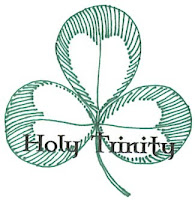 St. Patrick used a shamrock to explain the Trinity, three equal sized leaves sticked together. We can think about water, which maintains its chemical identity whether it is in a form of liquid, or ice, or steam. When Christ unites the divine and human natures in unity of his person, he shows the distance between the Father and the Son, and how it is defeated through individual person, the Holy Spirit. Jesus is constantly living in relation to the Father, through the Spirit. Father is the principle, Jesus is an instrument of the Father, and the Spirit is the motive force of the Father. In the Act of Consecration of Man - the Mass of The Christian Community, my denomination - we repeatedly hear: "The Father God be in us, the Son God create in us, the Spirit God enlighten us." And also: "Let it be through You, who carry and organize life of the world, as You receive it from the Father and heal by the Holy Spirit in all following aeons." (These are my translations, not the official ones!)
  Jung Young Lee, Korean theologian living in the United States, sees the oriental concept of Yin and Yang to help to represent the Trinity better than western theology. The Holy Spirit is the spirit of change, it is Yin, receptive. The Change (Creater, Father) is Yin or Spirit in relation to the Word (Son) or the centre of the creative force and process, which is Yang. Spirit is Yin, receptive to God's manifesting and saving activity, and the Creater-God is Yang in relation to Spirit, Yin. On the other hand, Spirit-Yin is the Word-Yang, and vice versa, because they both are participants in Change or Creater. All the time there is movement from unity to plurality, from one to three, and vice versa. Splitting of the unity and unifying of the splitted.
 The word Tao (Way) is used in Chinese translation of the Gospel according to John, "in the beginning there was Tao", and thus it also echoes the words "I am the way, and the truth, and the life". Tao existed before the universe, as immutable first principle, forefather of all that exists, through which everything came forth, or as Laozi said, "Tao gave birth to one, one has given birth to two, two to three, and three to all the creatures."
 St. Patrick used a shamrock to explain the Trinity, three equal sized leaves sticked together. We can think about water, which maintains its chemical identity whether it is in a form of liquid, or ice, or steam. When Christ unites the divine and human natures in unity of his person, he shows the distance between the Father and the Son, and how it is defeated through individual person, the Holy Spirit. Jesus is constantly living in relation to the Father, through the Spirit. Father is the principle, Jesus is an instrument of the Father, and the Spirit is the motive force of the Father. In the Act of Consecration of Man - the Mass of The Christian Community, my denomination - we repeatedly hear: "The Father God be in us, the Son God create in us, the Spirit God enlighten us." And also: "Let it be through You, who carry and organize life of the world, as You receive it from the Father and heal by the Holy Spirit in all following aeons." (These are my translations, not the official ones!)


