
Church Father Origen , in his work De Principiis, writes that in Christianity there are statements of Faith that must be believed in order to attain Salvation, and then there are such that can be debated upon. He starts his study of the necessary statements with trinitarian persons. Several Creeds of the Early Church tell us about development of the doctrine of the Trinity.
Is there Trinity in the Old Testament? St. Augustine interpreted Genesis 1 so that Christ and the Holy Spirit participated in Creation through the Word of God and the Spirit of God. Also before the Fall man was Imago Trinitatis, who loved the Lord with all his heart, and with all his soul, and with all his mind.
Is there Trinity in the Old Testament? St. Augustine interpreted Genesis 1 so that Christ and the Holy Spirit participated in Creation through the Word of God and the Spirit of God. Also before the Fall man was Imago Trinitatis, who loved the Lord with all his heart, and with all his soul, and with all his mind.
 In Genesis 18, Abraham and Sarah had three visitors near the great trees of Mamre. First it is said, "The Lord appeared", and then Abraham... "saw three men standing nearby". Sometimes he seems to talk to one person, and then three persons. This schene is depicted in a famous icon of the Trinity by Andrei Rublev, around 1410. Three men have been portrayed as the most important Archangels, Gabriel, Raphael, and Michael.
 Robert A. Powell explains how the three Patriarchs, Abraham, Isaac, and Jacob, each represent one quality of the Trinity: Abraham, perspective of the Father, impulse of founding; Isaac, perspective of the Son, impulse of sacrifice; Jacob, perspective of the Holy Spirit, impulse of fulfilling the purpose through the sacrifice. The Old Testament is the Testament of the Father, the New Testament is the Testament of the Son, and the Book of Revelation is the Testament of the Holy Spirit.
 When Jesus was baptised in river Jordan, a voice came from heaven calling him His Son, and a Spirit descended on him like a dove. The Great Commission in Matthew 28, "go and make disciples of all nations, baptizing them in the name of the Father and of the Son and of the Holy Spirit" has not been proven to be later addition in original text. In 2 Cor.13:14 St. Paul says, "May the grace of the Lord Jesus Christ, and the love of God, and the fellowship of the Holy Spirit be with you all." And in Gal.4:6 he says, "Because you are sons, God sent the Spirit of his Son into our hearts, the Spirit who calls out, 'Abba, Father.'" In the Gospel according to John, a doctrine of the Trinity is present more perfected than in any other book of the New Testament.
 Surprisingly perhaps, Trinity is present even in the Lord's Prayer. "Our Father" is evident without explanation, but the next phrase, "hallowed be your name", refers to Jesus Christ, for "God exalted him to the highest place and gave him the name that is above every name." (Phil.2:9) The third phrase, "your kingdom come", refers to the Holy Spirit, for "the kingdom of God is within you" (Luke 17:21) and "your body is a temple of the Holy Spirit, who is in you..." (1 Cor.6:19) In fact, in some old manuscripts this part reads, "your Holy Spirit come"! So we are not calling just our heavenly Father, but also Christ Jesus to be with us and the blessings of the Holy Spirit. Again in the doxology ("For the kingdom, the power, and the glory are yours now and for ever"), which is later addition but perfectly in place, we see three as one: the Kingdom, material aspect of the manifestation; the Power, one life force using material appearances and working through them; and the Glory, perfect result of this union.
In the teachings of the late Holy Order of MANS, the law of prayer is shown in a graphical form like this:
FATHER SON

HOLY SPIRIT
"When you contacted the Father, you were at the uppermost point of this triangle, marked "Father." When you asked for what you wanted, you moved your consciousness from the "Father" point of the triangle to the "Son" point of the triangle. When you received that for which you asked, this is shown in the motion from the "Son" through the "Holy Spirit"--the third point of the triangle."
Theophilus of Antioch, the 6th Bishop of the Church of Antioch after the apostles, according to Eusebius, seems to be the first thinker, who formed the classical concept of the Threefold God - Fatherhood, Intelligence (Logos), and Wisdom. God as the Father in eternity gives birth to His Logos or His Son, and the Holy Spirit as Wisdom is the integrative link between the two. Tertullian in turn was the first one to use a term "Trinity" - tres personae in una substantia - Three persons in one divine being. In culture of Antiquity, idea of unity of the Three was commonly known model of thought.
A concept of the Trinity is not restricted to Christianity. An average Westerner thinks about whole pantheon of gods and goddesses in relation with Hindu religion, but beyond these there exists Brahman, the One and the Only One, the Soul of the World, from which every manifestation emanates. It is the Absolute Oneness of the opposites, that no man can comprehend, and it can be described only by saying, "it is not this and it is not that". Meister Eckhart, a Christian Mystic, also believed in the One and Undiveded Essence of Godhead behind the Trinity, which he often characterized by German word, Grunt, meaning earth, soil, ground. It also corresponds to the ideas of Philo of Alexandria, Jewish philosopher and contemporary of Jesus, who had a great influence on early Church Fathers.
In Hindu philosophy, the Highest Being can be seen in different aspects, as Trimurti. Brahma (without n) is a creative aspect, like the Father, a cosmic mind. Vishnu is preserving aspect, like the Son, a cosmic Lord. Shiva is a destroyer of the bad things for renewal of the universe, like the Holy Spirit, a trancendent Godhead.
Hindu tradition also knows philosophical concept called "saccidananda"; Late Upanishads suggest that Brahman can be defined by three concepts - "sat", existence; "cit", concsiousness or intelligence; "ananda", bliss. Keshub Chandra Sen (1838-1884) was probably the first one to unite this idea with the Christian Trinity: the Father is Sat, the very existence, the infinite God. The Son is emanated from the Father, and He is the Logos penetrating the whole Creation, Cit. In His Son God descends to the bottom of humanity. The Holy Spirit raises humanity to heaven. The Holy Spirit is Ananda, the Comforter of the New Testament. (Here I owe thanks to Jyri Komulainen and his book Guru Jeesus; Tutkielma hindulaisuudesta ja kristinuskosta - "Guru Jesus; Study of Hinduism and Christianity", published in Finland 2006 )
Vengal Chakkarai (1880-1958), an Indian theologian, saw the Holy Spirit as the Spirit of Christ or even "Jesus himself". Jesus Christ is incarnation of God, and the Holy Spirit is incarnation of Jesus Christ in human experience. For Chakkarai, Pentecost is the third phase of incarnation after the birth and resurrection of Jesus. Instead of Jesus of history, Chakkarai places in the centre a "Spiritual Christ", present as a spirit. The Holy Spirit works silently as "inner dweller", and makes Christ present in the heart of the faithful.
 Jung Young Lee, Korean theologian living in the United States, sees the oriental concept of Yin and Yang to help to represent the Trinity better than western theology. The Holy Spirit is the spirit of change, it is Yin, receptive. The Change (Creater, Father) is Yin or Spirit in relation to the Word (Son) or the centre of the creative force and process, which is Yang. Spirit is Yin, receptive to God's manifesting and saving activity, and the Creater-God is Yang in relation to Spirit, Yin. On the other hand, Spirit-Yin is the Word-Yang, and vice versa, because they both are participants in Change or Creater. All the time there is movement from unity to plurality, from one to three, and vice versa. Splitting of the unity and unifying of the splitted.
 The word Tao (Way) is used in Chinese translation of the Gospel according to John, "in the beginning there was Tao", and thus it also echoes the words "I am the way, and the truth, and the life". Tao existed before the universe, as immutable first principle, forefather of all that exists, through which everything came forth, or as Laozi said, "Tao gave birth to one, one has given birth to two, two to three, and three to all the creatures."
The word Qi, referring to life force in Chinese philosophy, meaning the Breath of Life, has been used as translation for the Holy Spirit by Chinese theologian, Chang Ch’un-shen.
Sadhu Sundar Singh, Indian convert to Christianity, had many visions, and once he was caught up to the third heaven, like Paul, and he was looking around and asked "Where is God?" He was answered that God was as much visible as on earth, since God is infinite, but Christ was there and Christ is God, image of the invisible God in heaven and on earth. And sadhu tells us how he saw like waves of light and peace streaming from Christ through the saints and angels, as if a warm water refreshing trees, and he understood that it was the Holy Spirit.
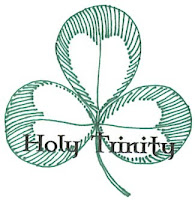 St. Patrick used a shamrock to explain the Trinity, three equal sized leaves sticked together. We can think about water, which maintains its chemical identity whether it is in a form of liquid, or ice, or steam. When Christ unites the divine and human natures in unity of his person, he shows the distance between the Father and the Son, and how it is defeated through individual person, the Holy Spirit. Jesus is constantly living in relation to the Father, through the Spirit. Father is the principle, Jesus is an instrument of the Father, and the Spirit is the motive force of the Father. In the Act of Consecration of Man - the Mass of The Christian Community, my denomination - we repeatedly hear: "The Father God be in us, the Son God create in us, the Spirit God enlighten us." And also: "Let it be through You, who carry and organize life of the world, as You receive it from the Father and heal by the Holy Spirit in all following aeons." (These are my translations, not the official ones!)
Vengal Chakkarai (1880-1958), an Indian theologian, saw the Holy Spirit as the Spirit of Christ or even "Jesus himself". Jesus Christ is incarnation of God, and the Holy Spirit is incarnation of Jesus Christ in human experience. For Chakkarai, Pentecost is the third phase of incarnation after the birth and resurrection of Jesus. Instead of Jesus of history, Chakkarai places in the centre a "Spiritual Christ", present as a spirit. The Holy Spirit works silently as "inner dweller", and makes Christ present in the heart of the faithful.
 Jung Young Lee, Korean theologian living in the United States, sees the oriental concept of Yin and Yang to help to represent the Trinity better than western theology. The Holy Spirit is the spirit of change, it is Yin, receptive. The Change (Creater, Father) is Yin or Spirit in relation to the Word (Son) or the centre of the creative force and process, which is Yang. Spirit is Yin, receptive to God's manifesting and saving activity, and the Creater-God is Yang in relation to Spirit, Yin. On the other hand, Spirit-Yin is the Word-Yang, and vice versa, because they both are participants in Change or Creater. All the time there is movement from unity to plurality, from one to three, and vice versa. Splitting of the unity and unifying of the splitted.
 The word Tao (Way) is used in Chinese translation of the Gospel according to John, "in the beginning there was Tao", and thus it also echoes the words "I am the way, and the truth, and the life". Tao existed before the universe, as immutable first principle, forefather of all that exists, through which everything came forth, or as Laozi said, "Tao gave birth to one, one has given birth to two, two to three, and three to all the creatures."
The word Qi, referring to life force in Chinese philosophy, meaning the Breath of Life, has been used as translation for the Holy Spirit by Chinese theologian, Chang Ch’un-shen.
Sadhu Sundar Singh, Indian convert to Christianity, had many visions, and once he was caught up to the third heaven, like Paul, and he was looking around and asked "Where is God?" He was answered that God was as much visible as on earth, since God is infinite, but Christ was there and Christ is God, image of the invisible God in heaven and on earth. And sadhu tells us how he saw like waves of light and peace streaming from Christ through the saints and angels, as if a warm water refreshing trees, and he understood that it was the Holy Spirit.
 St. Patrick used a shamrock to explain the Trinity, three equal sized leaves sticked together. We can think about water, which maintains its chemical identity whether it is in a form of liquid, or ice, or steam. When Christ unites the divine and human natures in unity of his person, he shows the distance between the Father and the Son, and how it is defeated through individual person, the Holy Spirit. Jesus is constantly living in relation to the Father, through the Spirit. Father is the principle, Jesus is an instrument of the Father, and the Spirit is the motive force of the Father. In the Act of Consecration of Man - the Mass of The Christian Community, my denomination - we repeatedly hear: "The Father God be in us, the Son God create in us, the Spirit God enlighten us." And also: "Let it be through You, who carry and organize life of the world, as You receive it from the Father and heal by the Holy Spirit in all following aeons." (These are my translations, not the official ones!)

